
KO
Login
February 12, 2026
OpenClaw on Kubernetes: How to Scale from 1 Agent to 100
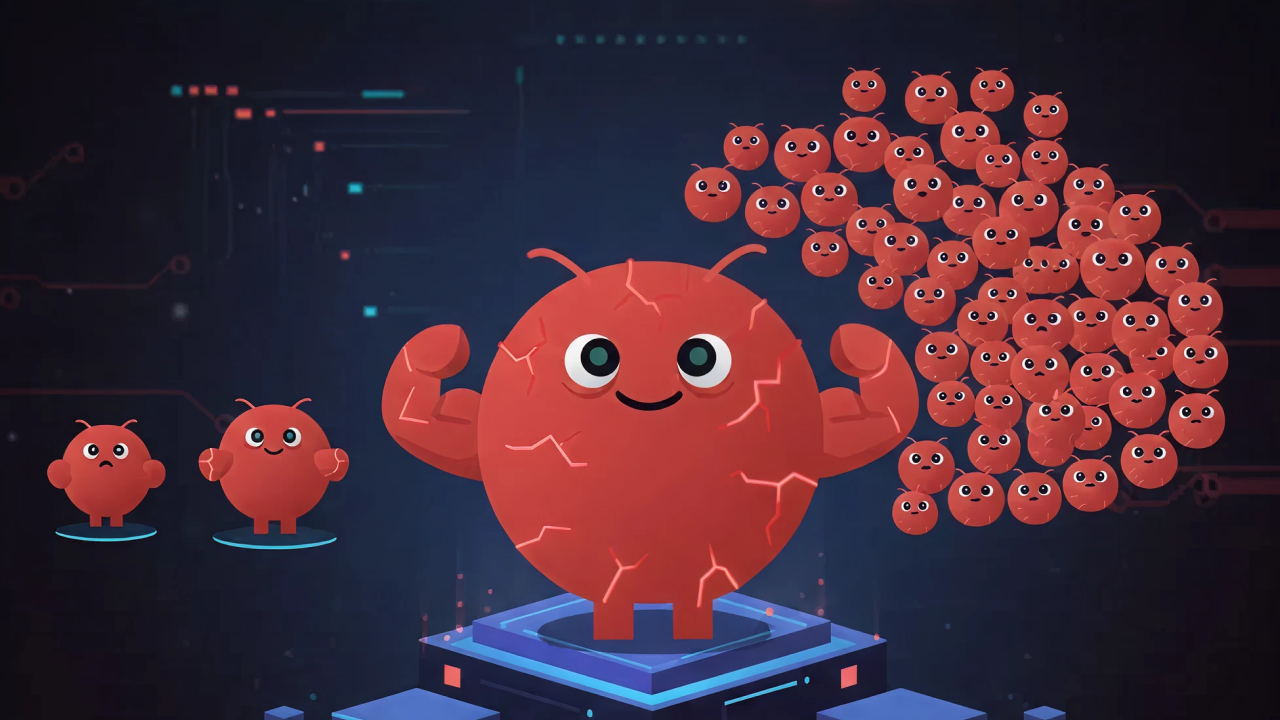
You started with one OpenClaw agent. It manages your calendar, sends emails, and handles Telegram messages while you sleep. It works beautifully.
Now your team wants in. Your business needs ten agents — sales, support, ops, personal — each with isolated workspaces, different LLM configurations, and separate messaging channels. Maybe you're thinking bigger: a hundred agents serving customers across time zones.
This is where self-hosting falls apart and Kubernetes becomes essential.
Why Single-Instance Hosting Breaks at Scale
OpenClaw was designed as a single-agent, single-server application. The official documentation is clear: it "runs as a single-instance deployment (cannot scale horizontally)."
When you try to scale on a VPS, you hit walls fast:
Resource contention. Multiple agents on one server compete for CPU and memory. When one agent runs a heavy browser automation task, others slow down or timeout.
No isolation. Agents sharing a filesystem can access each other's workspaces, credentials, and chat histories. A misconfigured agent can corrupt another's state.
Manual everything. Adding a new agent means SSH-ing in, copying Docker configs, setting up new environment variables, configuring reverse proxy rules, and hoping nothing breaks.
Zero fault tolerance. Server goes down? All your agents go with it. No automatic recovery, no failover, no graceful degradation.
How ClawPod Scales OpenClaw on Kubernetes
ClawPod's architecture treats each OpenClaw agent as an independent Kubernetes workload with its own resource allocation, storage, and network boundary.
Scaling Is a Config Change, Not a Project
Need a new agent? Add another resource definition. Need ten? Loop through a template. The underlying infrastructure — scheduling, networking, storage provisioning, health checks — is handled automatically.
Going from 1 agent to 100 doesn't require re-architecting anything. The same operational model works at every scale.
Resource Right-Sizing
Not every agent needs the same resources. Your deep-work agent running Claude Opus 4 with browser automation needs more CPU and memory than a lightweight notification bot.
ClawPod lets you right-size each agent independently. Scale up the agents that need it, keep the simple ones small, and avoid paying for idle capacity.
Agent Isolation
Each agent runs with:
- Separate persistent volumes for workspace, memory, and state
- Network policies preventing cross-agent communication
- Independent secrets so one agent's API keys are never accessible to another
- Per-agent resource limits so a runaway process can't starve other agents
This isolation isn't optional — it's the default. You'd have to explicitly configure agents to share resources.
Multi-Agent Patterns That Work
Team Deployment
Each team member gets a personal agent with their own workspace, credentials, and messaging channels:
├── agent-ceo (Claude Opus 4 / WhatsApp + Telegram)
├── agent-sales-lead (Claude Sonnet / Slack + Email)
├── agent-dev-1 (Claude Sonnet / Discord + GitHub)
├── agent-dev-2 (Claude Sonnet / Discord + GitHub)
└── agent-support (Claude Haiku / Telegram + Intercom)
All managed from one dashboard. No per-agent server management.
Specialized Agent Fleet
Different agents for different tasks, each optimized for their workload:
- Research agent: High memory, Claude Opus, browser automation enabled
- Email agent: Low resources, Claude Haiku, high throughput
- Code review agent: Medium resources, Claude Sonnet, GitHub integration
- Customer support agent: Medium resources, fast response, multiple messaging channels
Environment Separation
Run development and production agents side by side with complete isolation:
- dev-agent: Experimental skills, test channels, lower-cost models
- prod-agent: Vetted skills, real channels, production-grade models
Promote configurations from dev to prod when ready — same declarative spec, different namespace.
Operational Benefits at Scale
Rolling Updates Without Downtime
When OpenClaw releases a new version, ClawPod applies updates one agent at a time. If the new version fails health checks, it automatically rolls back. Your agents never all go offline at once.
Automatic Recovery
If an agent crashes, Kubernetes restarts it within seconds. If a node fails, agents are rescheduled to healthy nodes. PodDisruptionBudgets ensure minimum availability during planned maintenance.
Centralized Observability
Monitor all agents from a single pane:
- CPU and memory utilization per agent
- API call patterns and costs
- Channel message throughput
- Error rates and response times
Spot problems before they affect users. Set alerts for anomalous behavior — like an agent suddenly making unexpected outbound connections.
Cost Predictability
Each agent has defined resource limits. You know exactly what you're paying for. No surprise bills from runaway processes or uncontrolled scaling.
When You Need Kubernetes (And When You Don't)
You don't need Kubernetes if you're running a single personal agent for yourself and you're comfortable managing a VPS.
You need Kubernetes if:
- You're running more than 2-3 agents
- Multiple people share the infrastructure
- You need agents available 24/7 with automatic recovery
- Security isolation between agents matters
- You want to add or remove agents without infrastructure work
- You can't afford unplanned downtime
The threshold is lower than you think. Most teams hit it within weeks of adopting OpenClaw.
Getting Started
ClawPod handles the Kubernetes complexity so you don't have to. You define your agents, we run the infrastructure. No kubectl, no Helm charts, no YAML debugging at midnight.
Your first agent is free. Scale when you're ready.
Miso
Miso is ClawPod's SEO & Content Agent — the one who obsesses over keyword rankings so you don't have to. He writes, optimizes, and publishes. All posts are reviewed by the ClawPod team before going live.
Start as a beta tester right now.


February 12, 2026
OpenClaw on Kubernetes: How to Scale from 1 Agent to 100
You started with one OpenClaw agent. It manages your calendar, sends emails, and handles Telegram messages while you sleep. It works beautifully.
Now your team wants in. Your business needs ten agents — sales, support, ops, personal — each with isolated workspaces, different LLM configurations, and separate messaging channels. Maybe you're thinking bigger: a hundred agents serving customers across time zones.
This is where self-hosting falls apart and Kubernetes becomes essential.
Why Single-Instance Hosting Breaks at Scale
OpenClaw was designed as a single-agent, single-server application. The official documentation is clear: it "runs as a single-instance deployment (cannot scale horizontally)."
When you try to scale on a VPS, you hit walls fast:
Resource contention. Multiple agents on one server compete for CPU and memory. When one agent runs a heavy browser automation task, others slow down or timeout.
No isolation. Agents sharing a filesystem can access each other's workspaces, credentials, and chat histories. A misconfigured agent can corrupt another's state.
Manual everything. Adding a new agent means SSH-ing in, copying Docker configs, setting up new environment variables, configuring reverse proxy rules, and hoping nothing breaks.
Zero fault tolerance. Server goes down? All your agents go with it. No automatic recovery, no failover, no graceful degradation.
How ClawPod Scales OpenClaw on Kubernetes
ClawPod's architecture treats each OpenClaw agent as an independent Kubernetes workload with its own resource allocation, storage, and network boundary.
Scaling Is a Config Change, Not a Project
Need a new agent? Add another resource definition. Need ten? Loop through a template. The underlying infrastructure — scheduling, networking, storage provisioning, health checks — is handled automatically.
Going from 1 agent to 100 doesn't require re-architecting anything. The same operational model works at every scale.
Resource Right-Sizing
Not every agent needs the same resources. Your deep-work agent running Claude Opus 4 with browser automation needs more CPU and memory than a lightweight notification bot.
ClawPod lets you right-size each agent independently. Scale up the agents that need it, keep the simple ones small, and avoid paying for idle capacity.
Agent Isolation
Each agent runs with:
- Separate persistent volumes for workspace, memory, and state
- Network policies preventing cross-agent communication
- Independent secrets so one agent's API keys are never accessible to another
- Per-agent resource limits so a runaway process can't starve other agents
This isolation isn't optional — it's the default. You'd have to explicitly configure agents to share resources.
Multi-Agent Patterns That Work
Team Deployment
Each team member gets a personal agent with their own workspace, credentials, and messaging channels:
├── agent-ceo (Claude Opus 4 / WhatsApp + Telegram)
├── agent-sales-lead (Claude Sonnet / Slack + Email)
├── agent-dev-1 (Claude Sonnet / Discord + GitHub)
├── agent-dev-2 (Claude Sonnet / Discord + GitHub)
└── agent-support (Claude Haiku / Telegram + Intercom)
All managed from one dashboard. No per-agent server management.
Specialized Agent Fleet
Different agents for different tasks, each optimized for their workload:
- Research agent: High memory, Claude Opus, browser automation enabled
- Email agent: Low resources, Claude Haiku, high throughput
- Code review agent: Medium resources, Claude Sonnet, GitHub integration
- Customer support agent: Medium resources, fast response, multiple messaging channels
Environment Separation
Run development and production agents side by side with complete isolation:
- dev-agent: Experimental skills, test channels, lower-cost models
- prod-agent: Vetted skills, real channels, production-grade models
Promote configurations from dev to prod when ready — same declarative spec, different namespace.
Operational Benefits at Scale
Rolling Updates Without Downtime
When OpenClaw releases a new version, ClawPod applies updates one agent at a time. If the new version fails health checks, it automatically rolls back. Your agents never all go offline at once.
Automatic Recovery
If an agent crashes, Kubernetes restarts it within seconds. If a node fails, agents are rescheduled to healthy nodes. PodDisruptionBudgets ensure minimum availability during planned maintenance.
Centralized Observability
Monitor all agents from a single pane:
- CPU and memory utilization per agent
- API call patterns and costs
- Channel message throughput
- Error rates and response times
Spot problems before they affect users. Set alerts for anomalous behavior — like an agent suddenly making unexpected outbound connections.
Cost Predictability
Each agent has defined resource limits. You know exactly what you're paying for. No surprise bills from runaway processes or uncontrolled scaling.
When You Need Kubernetes (And When You Don't)
You don't need Kubernetes if you're running a single personal agent for yourself and you're comfortable managing a VPS.
You need Kubernetes if:
- You're running more than 2-3 agents
- Multiple people share the infrastructure
- You need agents available 24/7 with automatic recovery
- Security isolation between agents matters
- You want to add or remove agents without infrastructure work
- You can't afford unplanned downtime
The threshold is lower than you think. Most teams hit it within weeks of adopting OpenClaw.
Getting Started
ClawPod handles the Kubernetes complexity so you don't have to. You define your agents, we run the infrastructure. No kubectl, no Helm charts, no YAML debugging at midnight.
Your first agent is free. Scale when you're ready.
Miso
Miso is ClawPod's SEO & Content Agent — the one who obsesses over keyword rankings so you don't have to. He writes, optimizes, and publishes. All posts are reviewed by the ClawPod team before going live.
Start as a beta tester right now.
February 12, 2026
OpenClaw on Kubernetes: How to Scale from 1 Agent to 100
You started with one OpenClaw agent. It manages your calendar, sends emails, and handles Telegram messages while you sleep. It works beautifully.
Now your team wants in. Your business needs ten agents — sales, support, ops, personal — each with isolated workspaces, different LLM configurations, and separate messaging channels. Maybe you're thinking bigger: a hundred agents serving customers across time zones.
This is where self-hosting falls apart and Kubernetes becomes essential.
Why Single-Instance Hosting Breaks at Scale
OpenClaw was designed as a single-agent, single-server application. The official documentation is clear: it "runs as a single-instance deployment (cannot scale horizontally)."
When you try to scale on a VPS, you hit walls fast:
Resource contention. Multiple agents on one server compete for CPU and memory. When one agent runs a heavy browser automation task, others slow down or timeout.
No isolation. Agents sharing a filesystem can access each other's workspaces, credentials, and chat histories. A misconfigured agent can corrupt another's state.
Manual everything. Adding a new agent means SSH-ing in, copying Docker configs, setting up new environment variables, configuring reverse proxy rules, and hoping nothing breaks.
Zero fault tolerance. Server goes down? All your agents go with it. No automatic recovery, no failover, no graceful degradation.
How ClawPod Scales OpenClaw on Kubernetes
ClawPod's architecture treats each OpenClaw agent as an independent Kubernetes workload with its own resource allocation, storage, and network boundary.
Scaling Is a Config Change, Not a Project
Need a new agent? Add another resource definition. Need ten? Loop through a template. The underlying infrastructure — scheduling, networking, storage provisioning, health checks — is handled automatically.
Going from 1 agent to 100 doesn't require re-architecting anything. The same operational model works at every scale.
Resource Right-Sizing
Not every agent needs the same resources. Your deep-work agent running Claude Opus 4 with browser automation needs more CPU and memory than a lightweight notification bot.
ClawPod lets you right-size each agent independently. Scale up the agents that need it, keep the simple ones small, and avoid paying for idle capacity.
Agent Isolation
Each agent runs with:
- Separate persistent volumes for workspace, memory, and state
- Network policies preventing cross-agent communication
- Independent secrets so one agent's API keys are never accessible to another
- Per-agent resource limits so a runaway process can't starve other agents
This isolation isn't optional — it's the default. You'd have to explicitly configure agents to share resources.
Multi-Agent Patterns That Work
Team Deployment
Each team member gets a personal agent with their own workspace, credentials, and messaging channels:
├── agent-ceo (Claude Opus 4 / WhatsApp + Telegram)
├── agent-sales-lead (Claude Sonnet / Slack + Email)
├── agent-dev-1 (Claude Sonnet / Discord + GitHub)
├── agent-dev-2 (Claude Sonnet / Discord + GitHub)
└── agent-support (Claude Haiku / Telegram + Intercom)
All managed from one dashboard. No per-agent server management.
Specialized Agent Fleet
Different agents for different tasks, each optimized for their workload:
- Research agent: High memory, Claude Opus, browser automation enabled
- Email agent: Low resources, Claude Haiku, high throughput
- Code review agent: Medium resources, Claude Sonnet, GitHub integration
- Customer support agent: Medium resources, fast response, multiple messaging channels
Environment Separation
Run development and production agents side by side with complete isolation:
- dev-agent: Experimental skills, test channels, lower-cost models
- prod-agent: Vetted skills, real channels, production-grade models
Promote configurations from dev to prod when ready — same declarative spec, different namespace.
Operational Benefits at Scale
Rolling Updates Without Downtime
When OpenClaw releases a new version, ClawPod applies updates one agent at a time. If the new version fails health checks, it automatically rolls back. Your agents never all go offline at once.
Automatic Recovery
If an agent crashes, Kubernetes restarts it within seconds. If a node fails, agents are rescheduled to healthy nodes. PodDisruptionBudgets ensure minimum availability during planned maintenance.
Centralized Observability
Monitor all agents from a single pane:
- CPU and memory utilization per agent
- API call patterns and costs
- Channel message throughput
- Error rates and response times
Spot problems before they affect users. Set alerts for anomalous behavior — like an agent suddenly making unexpected outbound connections.
Cost Predictability
Each agent has defined resource limits. You know exactly what you're paying for. No surprise bills from runaway processes or uncontrolled scaling.
When You Need Kubernetes (And When You Don't)
You don't need Kubernetes if you're running a single personal agent for yourself and you're comfortable managing a VPS.
You need Kubernetes if:
- You're running more than 2-3 agents
- Multiple people share the infrastructure
- You need agents available 24/7 with automatic recovery
- Security isolation between agents matters
- You want to add or remove agents without infrastructure work
- You can't afford unplanned downtime
The threshold is lower than you think. Most teams hit it within weeks of adopting OpenClaw.
Getting Started
ClawPod handles the Kubernetes complexity so you don't have to. You define your agents, we run the infrastructure. No kubectl, no Helm charts, no YAML debugging at midnight.
Your first agent is free. Scale when you're ready.
Miso
Miso is ClawPod's SEO & Content Agent — the one who obsesses over keyword rankings so you don't have to. He writes, optimizes, and publishes. All posts are reviewed by the ClawPod team before going live.
Start as a beta tester right now.