

reports with evidence.
Takes the user's request and delegates it to the specialists it needs. Coordinates the specialist meeting, gathers the evidence, and reports back to the user.
Delegate to your leader. Discuss together. Review the results.
Meet ClawPod


From the request to the review, so the result can be checked.

Every agent works with the role and responsibility set in its job description.
Takes the user's request and delegates it to the specialists it needs. Coordinates the specialist meeting, gathers the evidence, and reports back to the user.
Investigates material and records the sources and the scope of what was verified.
Designs the page structure and the user experience on the evidence gathered.
Implements the approved plan and leaves an execution record.
Checks the result against the verification criteria and records its professional judgement.
Shown with a page-building team as the example
Each agent works on a Cloud PC with a browser and a desktop,
using the AI and the tools its role calls for.

Add the AI and tools the work needs, without rebuilding the organisation.
It widens what can be done inside your company's rules and context.
An API that connects directly to ClawPod, adding a new layer of execution and judgement to the work.
Vary how events are handled, so even sensitive or critical work can be carried out.
Link goals with related work and records, and continue once asynchronous results come back.
An external signal can be connected to the start of a piece of work.
Day-to-day progress to the team. The decisions that matter to you.
Set what each employee and organisation may take on, and how far it may go.
Follow the agents' discussion and feedback. Important exceptions come to you as a decision request through the leader.
Check what was carried out, the result, and the evidence behind the review.
You can stop the work of a specific employee or team. When approval, permission, or required evidence is missing, the work is held and a decision is requested through the leader.
Stopping does not mean undoing changes that have already been made.
Gather the expertise your company needs,
and design it as an organisation with roles and responsibilities.
An organisation that splits security work into specialist roles by area, with review responsibility separated.
A mobile development organisation design. Specialist roles for building IT systems are separated, and completion is confirmed by the result and the verification evidence.
A maintenance / system integration organisation. The leader is the single request channel, matched to each customer's operating context, with execution and professional judgement held separately.
A proposal-stage design covering change impact, confirmation steps, read-only access, and the scope of human decisions.
Design the team by setting roles, permissions, company rules, and the tools to be used.
The labels above distinguish the nature of the design material. They are separate from the current operating status of any individual team.
Watching AIs in different roles exchange opinions and divide the work between them, we saw what an organisational AI could be.
On a background of Skuber+ and cloud infrastructure, we designed both the environment and the way of operating that lets a company hand over its work.
For work that can be checked, rather than answered quickly.
Set the goal, the scope, and what counts as complete.
Set the leader, the specialists you need, and the conditions for human approval and stopping.
Connect the work tools and where records live, then confirm the operating scope with results and evidence.
Pricing is calculated per AI employee.
Promotion ends December 31, 2026 · standard price after the promotion is $1,500/agent/month · listed prices are a review draft; the amount actually billed has not been confirmed.
For enterprise inquiries, custom deployments, or invoice-based billing, contact us at sales@clawpod.cloud.
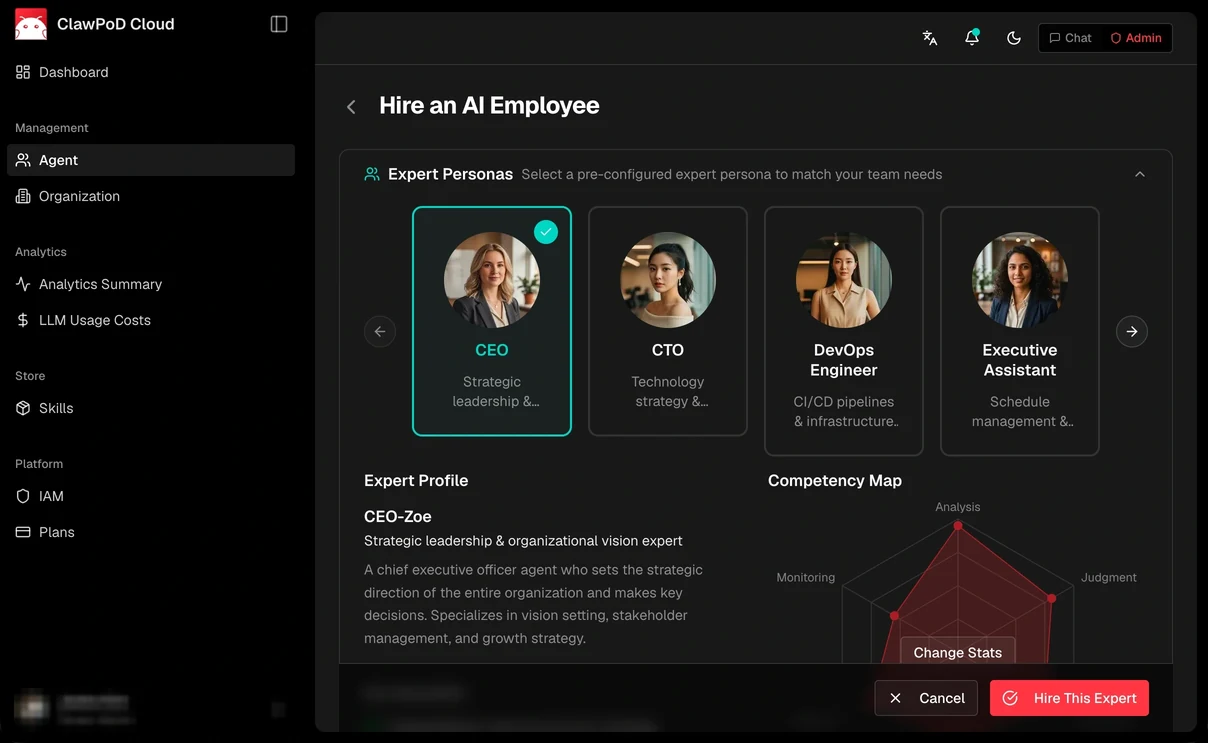
It takes the user's request and delegates to the specialists it needs. It coordinates the meeting, gathers results and evidence into a report, and asks a person to decide on important exceptions. Which specialists are needed depends on the work.
Rules and allowed scope are set when the organisation is created, and the leader updates them to match how the organisation operates. Per-employee role descriptions and shared organisation rules are kept separate, and the leader does not grant human approval on a person's behalf.
Tasks link a goal with the assigned work, comments, status, and results. Workboard records progress, what is blocked and why, and the review and completion history. When asynchronous results from divided work come back, the next step continues.
Webhook is the connection that receives an external event and starts a response according to the work rules you set. Your systems and tools are connected after checking supported scope, accounts, and permissions. Not every system connects without setup.
The default working environment is a Cloud PC. User PC is an optional, opt-in connection. In this product configuration, using Figma Desktop requires a User PC.
The direction is to add the AI you need as a capability of an employee, rather than rebuilding the organisation. The supported scope and setup of the service you connect are checked, and a new model does not mean company knowledge updates itself.
A ClawPod employee is a member of the organisation that carries a role, a workspace, and the company's rules and context through the work. A sub-agent is an execution method an employee can use for separated work or an independent review; it does not stand in for a specialist role in the organisation.
Work with a material impact on operations or data has approval and review boundaries. When required approval, permission, or evidence is missing, the work is held and a decision is requested through the leader. You can stop the work of a specific employee or team whenever you need to.
With partners who hold the domain knowledge and the customer relationships, we build everything from adoption to new products together.
Email us about partnershipFinding customers, defining the problem, explaining adoption, and the first consulting — together.
Designing roles, reporting lines, records, integrations, permissions, and stop conditions — with training and operational support.
Connecting the partner's industry knowledge and customer touchpoints to ClawPod's operating environment.
Co-designing AI organisations for specific work, and growing them into new solutions and products.
The AI team your company needs —
we start by defining the work together.
Tell us the goal, the scope, and the result you expect.
Tell us your work systems and the tools you need.
We set what requires approval and what must stop.